Religious Wall Clock Laser Cut CNC: A Guide to Digital Designs for Home Décor
The intersection of faith-based aesthetics and modern fabrication technology has created a unique niche in home décor: the Religious Wall Clock Laser Cut CNC. For hobbyists, small business owners, and DIY enthusiasts, these digital files offer a pathway to creating personalized, meaningful wall art without the need for advanced artistic drafting skills. Understanding what these files are, how they function, and what is required to produce high-quality results is essential for anyone considering this medium.
Understanding the Product Format
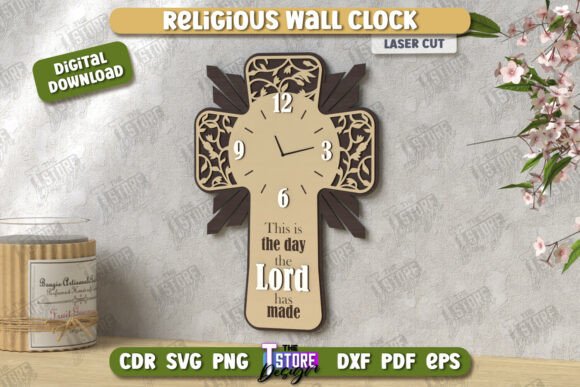
A Religious Wall Clock Laser Cut CNC product is not a physical item but a digital blueprint. It is a vector file designed specifically for computer numerical control (CNC) machines and laser cutters. These files contain precise geometric data that instructs the machine on where to cut through material and where to engrave surface details. The designs typically feature Christian symbols, such as crosses, ichthys fish, or scriptural verses, integrated into the functional structure of a clock face.
The utility of these files lies in their versatility. They are engineered to work with various laser cutting machines, allowing users to produce consistent, professional-grade décor pieces. However, the quality of the final output depends heavily on the user’s understanding of file formats and machine compatibility. Most packages include a zip archive containing multiple file types, such as SVG, EPS, PNG, PDF, and DXF. Each format serves a different purpose depending on the software and hardware being used.
Why Choose Laser-Cut Religious Décor?
There are several reasons why individuals and businesses are drawn to this specific type of digital product. Primarily, it offers a blend of spiritual expression and functional utility. A wall clock is a staple in most homes, and incorporating religious symbolism transforms a mundane object into a statement of faith. From a production standpoint, laser cutting allows for intricate details that would be difficult or time-consuming to achieve with manual tools like scroll saws or jigsaws.
For entrepreneurs, these files represent a low-overhead entry into the custom décor market. Since the product is digital, there is no inventory cost until a sale is made and the item is produced. This model supports made-to-order businesses, reducing waste and allowing for customization based on client preferences. Furthermore, the ability to choose different materials—such as wood, acrylic, or MDF—enables creators to match the aesthetic of various interior design styles, from rustic farmhouse to modern minimalist.
Technical Considerations and File Compatibility
One of the most critical aspects of working with a Religious Wall Clock Laser Cut Decorative Clock Christian Symbol Home Décor CNC File is understanding the technical specifications. The files are typically organized with color-coded lines to distinguish between operations. Generally, red lines indicate where the machine should cut through the material, while black lines indicate areas to be engraved or etched. Users must ensure their cutting machine and software interpret these colors correctly to avoid errors during production.
File format selection is another pivotal decision. While SVG files are widely supported and easy to edit in many design programs, they can sometimes cause dimensional distortions in certain software environments. Specifically, users of Lightburn, a popular laser control software, may encounter scaling issues when importing SVG files. In such cases, the DXF file format is often recommended as it tends to maintain precise dimensions and vector integrity. Evaluating which format works best with your specific workflow is a necessary step before beginning any project.
Additionally, the inclusion of PNG files provides a raster image option, which can be useful for previewing the design or for use in non-vector applications. However, for actual cutting, vector formats like DXF, SVG, or EPS are superior because they define paths rather than pixels, ensuring clean edges and accurate cuts regardless of the size scaling.
Benefits and Tradeoffs
The primary benefit of using pre-designed CNC files is efficiency. Creating a complex clock face with balanced symmetry and legible numerals requires significant design expertise. By purchasing a ready-made file, users save hours of drafting time and avoid potential mathematical errors in gear ratios or hand placements. Moreover, these files are often optimized for material usage, helping to minimize waste.
However, there are tradeoffs to consider. Relying on stock designs means that the final product may lack uniqueness if many other creators use the same file. To mitigate this, users can modify the files if they have vector editing skills, changing fonts, adding personal touches, or adjusting dimensions. Another consideration is the learning curve associated with laser cutting. Beginners may struggle with settings such as power, speed, and focus, which can affect the quality of the cut and engraving. Poorly calibrated machines can result in charred edges or incomplete cuts, diminishing the aesthetic appeal of the religious symbol.
Situations Where This Product Is a Strong Fit
This digital product is an excellent choice for individuals who already own or have access to a laser cutter and are looking to expand their portfolio of sellable items. It is also suitable for church groups or community centers wishing to create affordable, meaningful gifts or décor for their facilities. If you are comfortable with basic file management and have experience setting up laser jobs, these files provide a reliable foundation for production.
Furthermore, if you are interested in creating layered 3D effects by stacking multiple cut layers, these files often serve as a great base. The precision of CNC cutting ensures that layers align perfectly, allowing for sophisticated depth and shadow play in the final clock assembly.
When to Consider Alternatives
If you do not possess a laser cutting machine, this product may not be immediately useful unless you plan to outsource the cutting to a local makerspace or service bureau. In such cases, the cost of outsourcing might outweigh the benefits of buying a digital file versus purchasing a finished product. Additionally, if you require highly customized theological imagery that is not represented in standard Christian symbols, you might need to commission a custom designer rather than relying on stock CNC files.
Those who prefer traditional woodworking methods, such as hand-carving or routing, may find that laser-cut designs lack the organic texture and artisanal feel they desire. While laser cutting is precise, it produces a uniform look that differs from handcrafted items.
Making the Right Decision
To determine if a Religious Wall Clock Laser Cut CNC file aligns with your goals, assess your current technical capabilities and equipment. Ensure your software can handle the provided file types, particularly DXF or SVG, and verify that your machine can accommodate the size and material thickness specified in the design. If you are new to laser cutting, start with simpler projects to understand how your machine interprets cut and engrave lines.
It is also advisable to communicate with the seller if you have specific needs. Many creators are willing to provide alternative file types or adjust PNG sizes upon request. Clear communication can prevent compatibility issues and ensure a smoother production process. By carefully evaluating these factors, you can leverage these digital assets to create beautiful, faith-inspired décor that meets both aesthetic and functional standards.